Can a phone be a color meter?
It can, if it is honest about each reading. A phone camera reads kelvin and tint from the light it sees, which is what you need to set a white balance or pick a gel. On cheap LEDs and fluorescent tubes no camera can pin the color down, and a good meter app says so instead of guessing.

Night in an attic. Candles on a side table, a warm wash on the painted backdrop, a gap in the roof boards letting in a little cool light. The color meter is on the truck, two flights down.
You have a phone in your pocket. The question is simple: can it tell you whether the backdrop and the candles are close enough, and whether to reach for a quarter or an eighth?
What a phone camera sees
A dedicated color meter measures the light with a sensor built for that one job, and the best of them read the whole spectrum. A phone camera works differently. Its sensor sees through red, green and blue filters, and the camera works out the color of the light from what it sees, the same way it sets its own white balance. A meter app reads that estimate as kelvin and tint, from the whole frame or from a gray card that fills it.
That is a real reading of the light in front of you, taken the way a camera takes it. It is also an estimate, so what matters is whether it tells you when to doubt it.
A meter you can trust
Watch the badge as the reading settles: LOW, MEDIUM, then HIGH when the number is worth writing down. On a cheap LED or a fluorescent tube, the kind of spiky light no camera can pin down, it says DIFFICULT SOURCE rather than making one up. It is a camera used as a meter, not a spectrometer, and it knows the difference. If you own a reference meter, calibrate against it and this one reads like it.
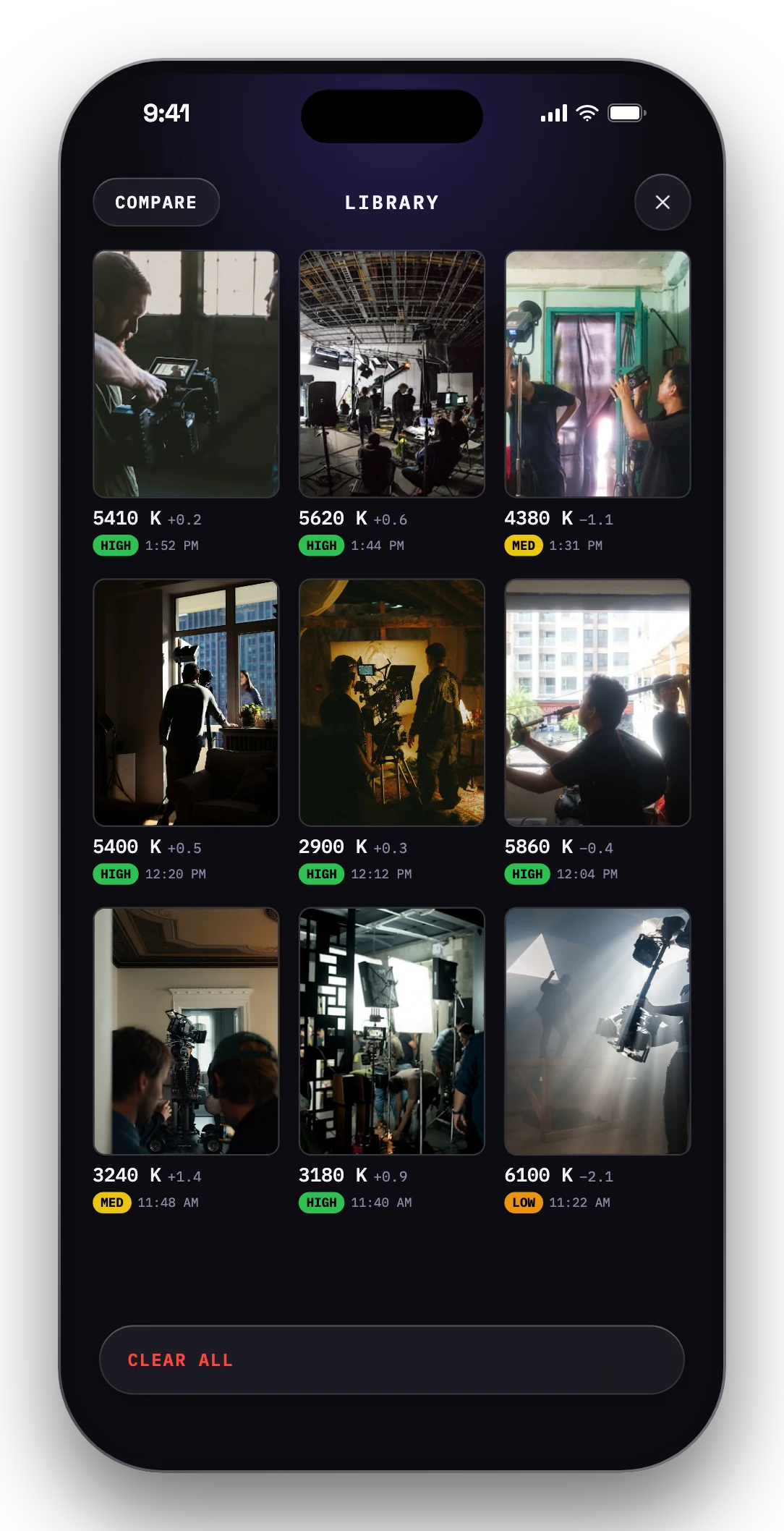
That badge is the part to look at. It comes from how much the last few dozen samples agree. Move the phone and the samples scatter, so it drops to LOW. Hold it on a steady lamp and they settle, so it climbs to HIGH. By a candle it stays at MEDIUM, because a flame never sits still, and that is the right answer.
What the badge is telling you
| Badge | What it means | What to do |
|---|---|---|
| HIGH | The recent samples agree closely | Write it down |
| MEDIUM | The reading is still wandering a little, like a flame or a card that is moving | Hold still and read again, or note it as MEDIUM |
| LOW | A real swing, or too few samples yet | Wait for it to settle |
| LOW · DIFFICULT SOURCE | RAW and the camera's estimate disagree by more than 15 mired | Treat it as a starting point and test on camera |
The badge comes from the spread of the most recent samples, the same way the app decides it on set.
Where a phone stops
Spiky light is the hard limit. Fluorescent tubes, budget LEDs and sodium street lights put their energy in a few narrow spikes, and a camera's three filters can land on very different answers depending on where those spikes fall. In Cutvey Meter you hold LOG for a RAW reading, measured from the sensor without the camera's own white balance, and compare it with the camera's estimate. When the two are more than 15 mired apart, it says DIFFICULT SOURCE and asks you to treat the reading as a starting point, not a measurement.
There are other things a phone does not do. It will not give you a spectrum or a color rendering score for a new LED you are thinking of renting. Its lux figure is worked out from the exposure, not measured by an incident dome, so for lighting ratios a light meter is still the tool. And it reads what the camera sees, so a frame full of red jacket reads the jacket, which is why the gray card matters.
If you own both
Keep the meter. Calibrate the phone against it once, lens by lens: the app keeps an offset in mired for each lens, and logged readings are stored uncorrected, so nothing is lost if you change your mind. Then the reference meter stays with the gaffer, and the phone is the one in your pocket on the walk-through, on the scout and between setups, keeping every reading with the frame it came from.
Can a phone be a color meter? For setting a white balance, matching two lights and picking the sheet that closes the gap, yes, as long as it tells you how sure it is. On the lights no camera can read, the honest answer is to say so, and that is what it does.