How much ND do you need?
At ISO 800 with a 180° shutter at 24 fps, a window-lit room of about 940 lux needs ND 0.9 at T2.8: three stops. Each 0.3 of density takes away one stop, half the light. Stop down to T4 and ND 0.6 is enough. In full sun at T2.8 you need about ND 2.8, over nine stops.
The ND calculator

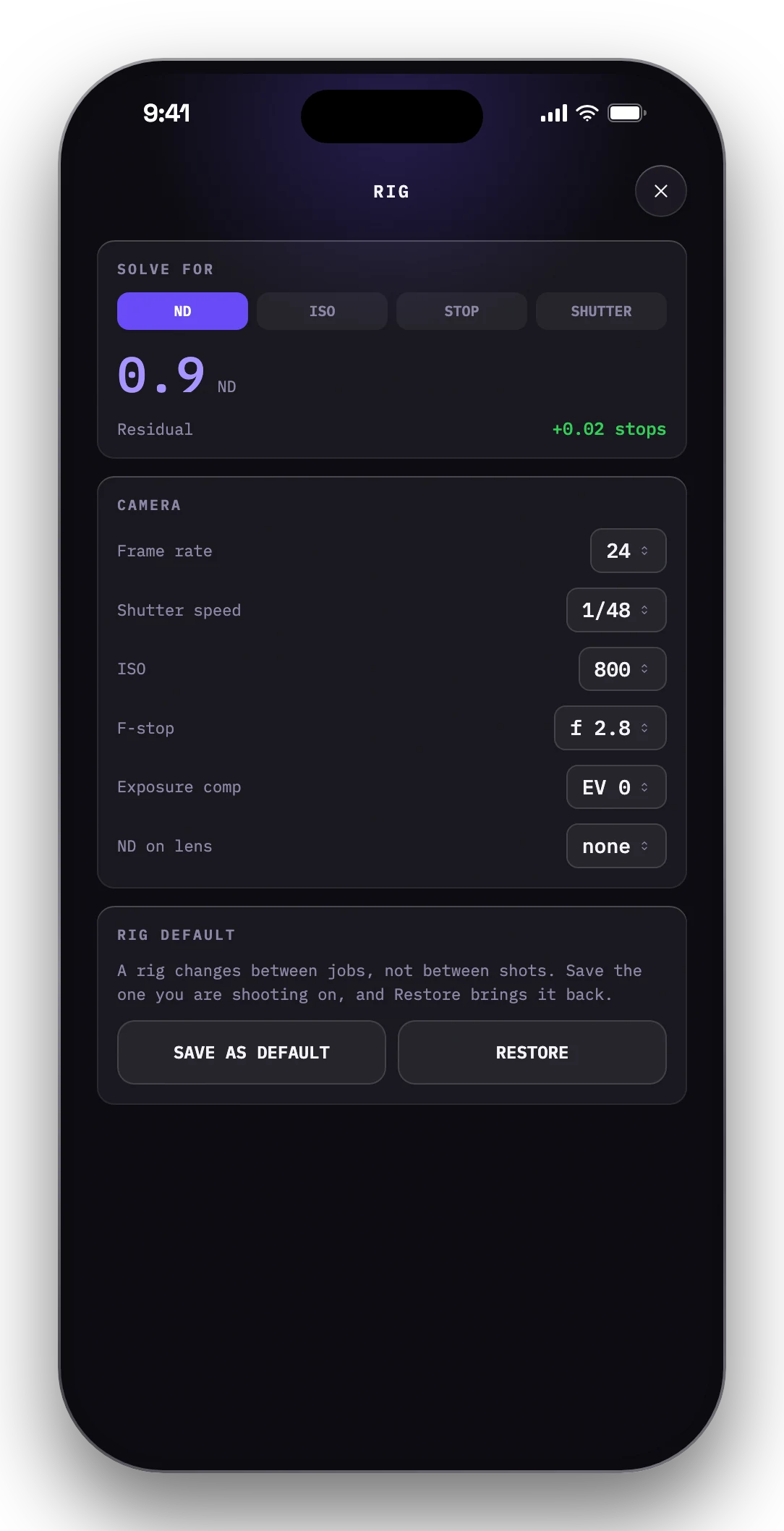
Reading the sheet
SOLVE FOR picks the one figure the sheet works out. The other three are yours to set under CAMERA.
Residual is what is left over, in stops. It turns green when the answer lands within 0.05 of a stop.
ND on lens is the filter already in the matte box. Solve for ISO, the stop or the shutter and the sheet works around it.
Exposure comp follows the camera's dial: plus is brighter, so it needs less ND.
On the meter card
In the app this line sits under the reading and keeps up with the light in front of you.
The working, in stops
- LIGHT
- log₂(944 lx ÷ 2.5)
- 8.56
- CAMERA
- T 2.8 · 1/48 · ISO 800
- 5.56
- GAP
- LIGHT − CAMERA − EV 0
- +3.00
- ND
- 3.00 stops × 0.3
- 0.90
- LEFT
- after that filter
- +0.00
ND for the light you meet every week
ISO 800 · 180° · 24 FPS| The light | T 2.0 | T 2.8 | T 4.0 | T 5.6 | T 8.0 | Load |
|---|---|---|---|---|---|---|
| Window-lit roomEV 8.6 · 944 lx | ND 1.24 stops | ND 0.93 stops | ND 0.62 stops | ND 0.31 stop | NO NDno filter | |
| Heavy overcast or open shadeEV 12 · 10k lx | ND 2.27.4 stops | ND 1.96.4 stops | ND 1.65.4 stops | ND 1.34.4 stops | ND 1.03.4 stops | |
| Cloudy bright, no shadowsEV 13 · 20k lx | ND 2.58.4 stops | ND 2.27.4 stops | ND 1.96.4 stops | ND 1.65.4 stops | ND 1.34.4 stops | |
| Hazy sun, soft shadowsEV 14 · 41k lx | ND 2.89.4 stops | ND 2.58.4 stops | ND 2.27.4 stops | ND 1.96.4 stops | ND 1.65.4 stops | |
| Full sun, hard shadowsEV 15 · 82k lx | ND 3.110.4 stops | ND 2.89.4 stops | ND 2.58.4 stops | ND 2.27.4 stops | ND 1.96.4 stops | |
| Sun on sand or snowEV 16 · 164k lx | ND 3.411.4 stops | ND 3.110.4 stops | ND 2.89.4 stops | ND 2.58.4 stops | ND 2.27.4 stops |
Worked out with the app's exposure math and rounded to 0.1 of density. The daylight rows use the exposure values photographers have long used for each kind of sky; real light moves with weather, time and place, and on set the app reads it through your camera.
One filter, three names
0.9, 3 stops and ND8 are the same filter. Every 0.3 of density is one stop, and every stop halves the light, so ND 0.9 lets through an eighth of it. Stack two filters and their densities add up. The app writes filters whichever way your kit is labeled.
| OD | Stops | Factor | Light through |
|---|---|---|---|
| 0.3 | 1 STOP | ND2 | 1/2 |
| 0.6 | 2 STOPS | ND4 | 1/4 |
| 0.9 | 3 STOPS | ND8 | 1/8 |
| 1.2 | 4 STOPS | ND16 | 1/16 |
| 1.5 | 5 STOPS | ND32 | 1/32 |
| 1.8 | 6 STOPS | ND64 | 1/64 |
| 2.1 | 7 STOPS | ND128 | 1/128 |
| 2.4 | 8 STOPS | ND256 | 1/256 |
| 2.7 | 9 STOPS | ND500 | 1/512 |
| 3.0 | 10 STOPS | ND1000 | 1/1024 |