How do you white balance on set?
Put an 18% gray card where the talent will stand, in the light that will hit their face, and fill the frame with it. Read the kelvin and the tint off that card, dial both into the camera, and read again whenever a lamp moves or the sun does.

Twenty minutes to the first shot. There are two big bounce boards frame left, a warm lamp behind the tinsel, teal practicals glowing along the far wall and a party light turning over all of it. The DP asks what to set the camera to.
The honest answer is that it depends where the talent stands. White balance is set for the light that lands on the face, and on a set like this every mark gets a different mix.
Read the light where the face will be
Walk the card to the mark. Hold it at chin height, turned the way the face will turn, so it catches the key and the fill in the same mix the skin will. If you hold it flat to the key you read the key alone, and the fill side of the face can be a long way off.
Keep your own shadow off it, and keep the frame full of card. Anything else in the frame, a bright wall, a warm floor, the talent's red jacket, pulls the reading toward its own color. That is why the card is gray: it is made to be neutral, so whatever color it shows is the light's. A white wall can do the job in a pinch, but walls are rarely as white as they look.
Set kelvin and tint
Kelvin is the warm to cool part of the color, the line that runs from candle to tungsten to daylight to open shade. Tint is the other axis, green to magenta. Tungsten lamps and the sun sit almost on the kelvin line, so on those you can often get away with kelvin alone. LEDs, tubes and mixed spaces drift off it, and that is where tint earns its place.
Most cinema cameras take both as numbers. Many can also white balance off a card with a button, and that works, but a number you dial in can be written on the camera report, repeated tomorrow on the pickup day and handed to the colorist. That is the case for reading the light rather than letting the camera guess.
In mixed light, decide what is white
On a set like the rink you will never make every source neutral at once, and you would not want to. Balance for the light on the face, then look at what everything else does relative to it. A practical reading warmer than the key usually reads as a lamp, which is the point of it. A window reading much cooler reads as daylight outside.
The question is how far apart they are, and kelvin is a poor ruler for that. The same 500 K gap is a big shift at the warm end and a small one at the cool end. Gels and meters talk in mired, a million divided by the kelvin, because a mired step looks the same size wherever it happens. Two lights within about 5 mired of each other read as the same light. The further past that, the more it shows on skin.
Where common sources sit
| Source | Kelvin | Mired |
|---|---|---|
| Candle | 1900 K | 526 |
| Household bulb | 2700 K | 370 |
| Tungsten film lamp | 3200 K | 313 |
| HMI, daylight LED | 5600 K | 179 |
| Overcast sky | 6500 K | 154 |
Typical ratings and published figures. Real lamps drift with age, dimming and voltage, and daylight moves all day, which is why you read them.
Doing it with Cutvey Meter
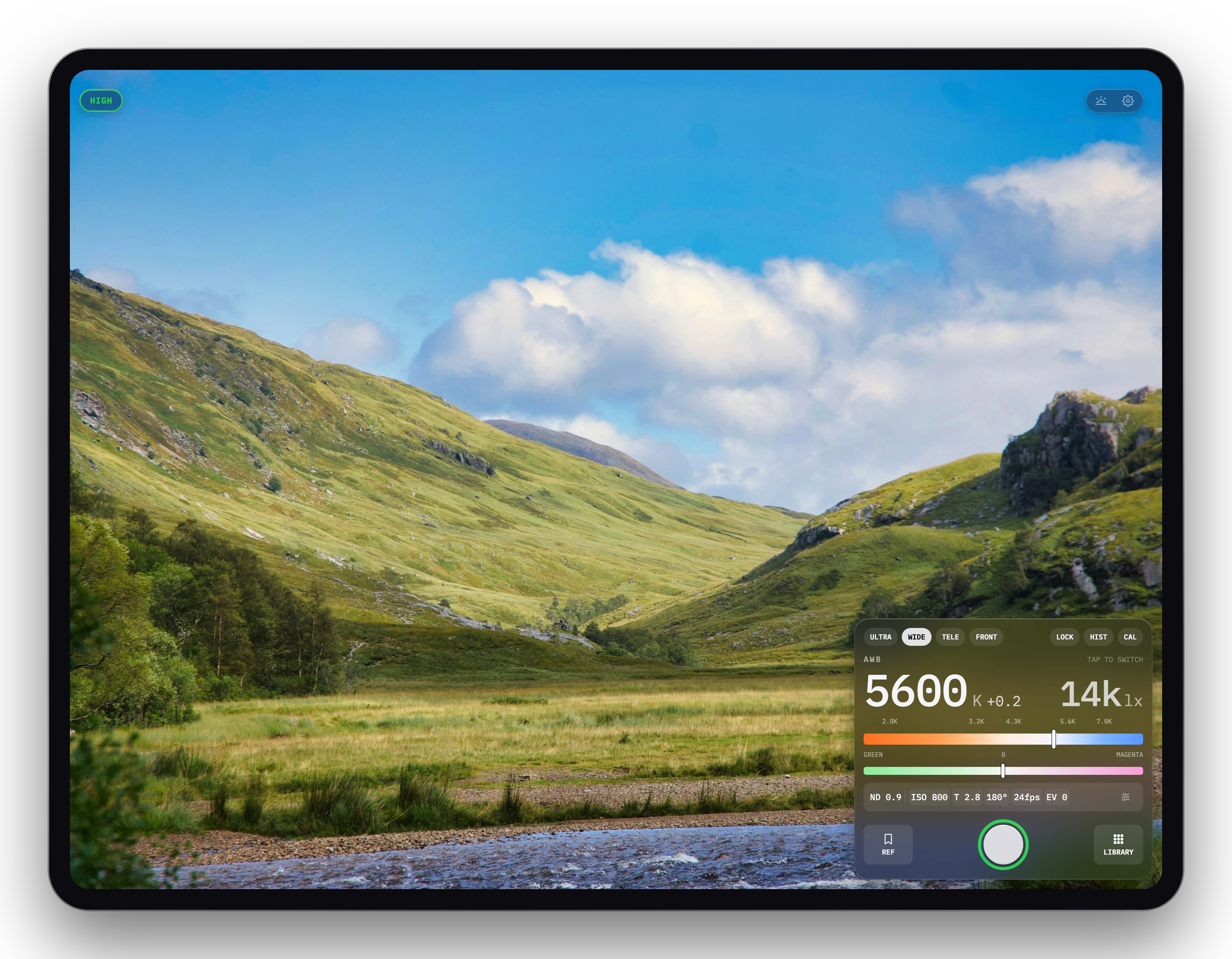
The meter opens on AWB, which reads the whole frame the way the camera would. Tap the reading to switch to GRAY CARD, then fill the frame with the card, as the app asks you to. The reading settles in a second and the badge says how sure it is: LOW while it is still moving, then MEDIUM, then HIGH when the number is worth writing down.
Tap LOG and the reading is kept with the frame you were pointing at, the lens and the exposure. On a light you do not trust, hold LOG for a RAW reading. If the RAW measurement and the camera's own estimate disagree by more than 15 mired, the badge says DIFFICULT SOURCE, and you treat the number as a place to start, not an answer.
Read again when anything moves
A white balance is only true for the light you read. The sun moves through a window over the afternoon. A tungsten lamp dimmed down goes warmer. Someone swaps a bulb in a practical between setups. None of it is dramatic on its own, and all of it shows up when the shots are cut together.
So read at every new setup, and after any change to the lamps. Write the kelvin and tint on the camera report next to the shot. When the edit needs a pickup three weeks later, the numbers are there, and so is the frame they came from.